COMPANY NEWS
General Introduction Of Chipboard Screw
1. What are Chipboard Screws
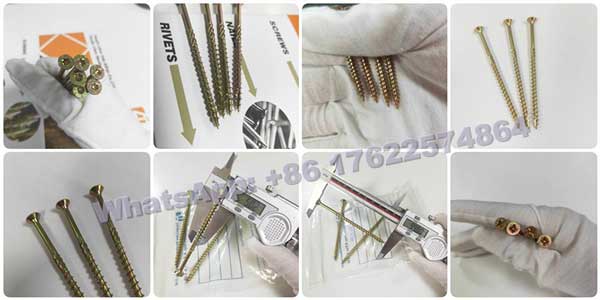
Chipboard screw also called particleboard screw. Chipboard screws are heat-treated and suitable for power tool installation. They are primarily optimized for higher penetration speeds and address the problem of cracking when used on hardwood. They are highly technical.
2. Characteristics of Chipboard Screws
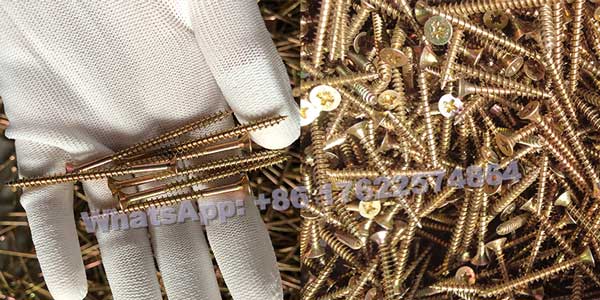
Chipboard particleboard screw are primarily used for connecting and fastening wood panels and between wood panels and thin steel sheets. They can largely replace ordinary wood screws (which are not heat-treated). Chipboard particleboard screw have a single thread and a single point, making them much faster than wood screws. Their different end shape makes them less susceptible to cracking.
Chipboard particleboard screws are suitable for use with a variety of woods and are an excellent tool for DIY furniture builders. They are characterized by their high hardness (due to heat treatment) and deep threads suitable for connecting wood. They are also easy to use. Small sizes can be screwed directly into wood without pre-drilled holes, while larger sizes can be screwed directly into wood with a single pre-drilled hole.
Fiberboard is made from wood or plant fibers. These fibers are mechanically separated into individual fibers, then added with additives to form a slab. These are then combined into artificial boards using heat pressing or adhesives.
3. Classification of Chipboard Particleboard Screws
Currently, there are a wide variety of chipboard fixings on the market, and they can be categorized in several ways.
Based on slot type, chipboard fixing are classified as: Pozi drive, Phillips, Torx and Square. The Pozi drive and Phillips slots function identically, except that the Pozi drive has two additional diagonal lines. Otherwise, their uses are the same, and the Phillips and Pozi drive are more commonly used. Comparatively, the Torx and Square slots have a lower market share.
Based on head type, they can be classified as: Countersunk and Wafer. Countersunk heads are the most commonly used, while Wafer heads are generally non-standard.
Currently, the most common types on the market are the Pozi drive double CSK chipboard fixing, and the Cross single CSK chipboard fixing. These are typically plated with yellow zinc or blue-white zinc. Special requirements may require the head to have ribs, typically four or six, and the tail with cutting. Chipboard fixings are generally full-thread, wood screws are generally half-thread, and drywall screws are generally double-threaded. Drywall screws, also known as double-threaded. Chipboard screws are single-threaded and have a shallower thread angle than drywall screws.
Compared to drywall screws, heat treatment requirements require a higher surface hardness and a deeper penetration layer than those of chipboard particleboard screw. For use on wood, drywall screws have a lower bite force than chipboard, which means the critical force for a drywall screw to slip out is lower than that of chipboard particleboard screw.
Compared to self-tapping screws. Self-tapping screws have shallower threads and cannot provide sufficient tension for wood, especially particleboard. However, due to their high hardness, screws with shallower threads like self-tapping screws can provide sufficient tension for iron.
Each screw is designed for a specific application. Using different screws for different materials can achieve better fastening results.